Jazz Chord Progressions
The jazz chord progressions worth learning first are the ii–V–I, its minor twin iiø7–V7b9–i, the fourths cycle behind "Autumn Leaves", the rhythm-changes bridge and Coltrane changes. They're written out below with voicings and tempos. Free in your browser, Veena gives you a personal music producer, CoProducer, that reads the changes and comps them on a real instrument.
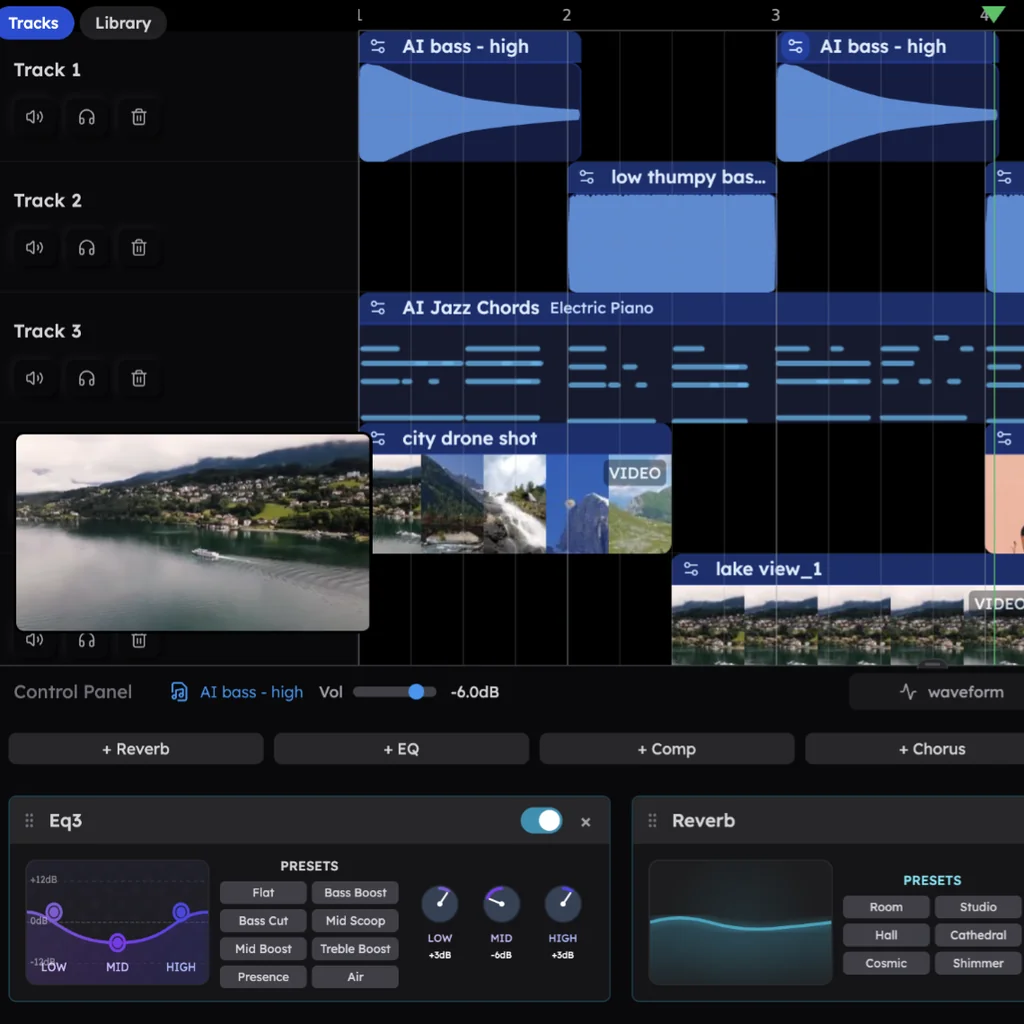
Five jazz chord progressions, from standard to advanced
1. The ii–V–I (Eb major)
- Changes: Fm9 – Bb13 – Ebmaj9 (ii9 – V13 – Imaj9)
- Voicing: rootless, over a bass on F2, Bb1, Eb2. Fm9 as Ab3–C4–Eb4–G4, Bb13 as Ab3–C4–D4–G4, Ebmaj9 as G3–Bb3–D4–F4.
- Feel: 132 BPM medium swing, comped in a Charleston rhythm: a short chord on beat 1 and another on the "and" of 2.
From Fm9 to Bb13 only one note moves: Eb falls to D. That economy is why the cadence sits under nearly every standard. The hand plays colour (ninths, the thirteenth) while the bass takes the roots.
2. The minor ii–V–i (D minor)
- Changes: Em7b5 – A7b9 – Dm6 (iiø7 – V7b9 – i6)
- Voicing: G3–Bb3–D4–E4, then G3–Bb3–C#4–E4, then F3–A3–B3–D4, over E2, A1, D2.
- Feel: a 66 BPM ballad on the Brush kit, one chord per bar.
Again one note moves into the V: D slides to C#. Look at the A7b9 without its root: C#–E–G–Bb is a C# diminished seventh, which is why jazz players treat diminished chords as dominants. Into Dm6, every voice steps down, and the B natural (the sixth) keeps the minor chord from sounding final.
3. The fourths cycle behind "Autumn Leaves" (E minor)
- Changes: Am7 – D7 – Gmaj7 – Cmaj7 – F#m7b5 – B7 – Em (iv7 – bVII7 – bIIImaj7 – bVImaj7 – iiø7 – V7 – i)
- Voicing: shells of third and seventh, G3–C4, F#3–C4, F#3–B3, E3–B3, E3–A3, D#3–A3, then E3–G3 on the final Em, over the roots.
- Feel: 120 BPM, one chord per bar, the bass walking.
Read it in G major and it's ii–V–I–IV, then a minor ii–V–i into E minor. The roots climb by fourths all the way, with one tritone step (C to F#) to stay in the key. In the shells, one note holds and the other steps down on every change until B7, then both resolve into Em. That line is what a soloist hears.
4. The rhythm-changes bridge (Bb major)
- Changes: D7 – G7 – C7 – F7, two bars each (III7 – VI7 – II7 – V7)
- Voicing: F#3–C4, F3–B3, E3–Bb3, Eb3–A3 over D2, G2, C3, F2.
- Feel: up-tempo, around 220 BPM, on the Jazz kit.
Each chord is the V of the next, marching round the circle to F7, the V of Bb. In the shells, both notes slide down a half step every two bars, so the whole bridge is two chromatic lines. It's the bridge of rhythm changes, the "I Got Rhythm" form that bebop players built tune after tune on.
5. Coltrane changes (C major)
- Changes: Cmaj7 – Eb7 – Abmaj7 – B7 – Emaj7 – G7 – Cmaj7 (Imaj7 – bIII7 – bVImaj7 – VII7 – IIImaj7 – V7 – Imaj7)
- Feel: learn it around 120 BPM before you take it fast.
Three key centres, C, Ab and E, sit a major third apart and split the octave into equal parts. Each is approached by its own dominant (Eb7 to Ab, B7 to E, G7 to C), which is what makes the jumps sound inevitable instead of random.
The voice-leading habit behind all five
Every progression above works the same way underneath: the third and seventh of each chord, the guide tones, move by a half or whole step to the next chord's guide tones. Hear that line and you can play through any tune. Keep the voicings between about C3 and G4, so the bass owns the bottom octave and the melody the top.
Comp them with CoProducer
Start at daw.veena.studio (Google sign-in, nothing to install) and paste:
Make a medium-swing jazz trio at 126 BPM in E minor, 16 bars: the changes Am7 | D7 | Gmaj7 | Cmaj7 | F#m7b5 | B7 | Em | Em, played twice. Electric Piano comping rootless voicings in a Charleston rhythm (beat 1 and the and of 2), an Acoustic Bass walking quarter notes with a chromatic approach into each chord, and the Jazz kit with the ride swinging and the hi-hat on 2 and 4. Warm and relaxed.
CoProducer offers three comping options first. Pick the one whose top note moves least, because the bass is walked against the voicings you choose. In Veena's own data, 84.5% of new users whose first request asks for jazz get a first result on day one.
Then edit like a pianist. Double-click the Electric Piano clip to open the piano roll:
- Set the snap to 1/3 Beat, so anything you drag lands on the swung triplet grid.
- For a drop-2 voicing, select the second note from the top of a chord and press Ctrl/Cmd+↓.
- Highlight bars 5 to 8 and ask CoProducer to "re-voice these with the ninth on top". Only that region changes, and one undo reverses it.
Want the bass line on its own? The bassline generator walks a line through any changes, and the chord progression generator drafts new ones. For the drums, form and mix of a full tune, see how to make jazz music.
Habits that make the changes sound stiff
- Root-position blocks. Four-note chords with the root at the bottom clash with the bass and jump around. Go rootless.
- Every chord on beat 1. Comping answers the soloist; anticipate the "and" of 4 now and then.
- Extensions everywhere. A b9 belongs on a dominant heading to minor, not on every chord in the tune.
- Ignoring the form. Changes live inside 12-bar and 32-bar forms; loop the whole form, not two bars.
Jazz harmony slowed down and softened becomes neo soul chord progressions; sped up and set in church, it becomes gospel chord progressions.
Try this in Veena
Make a medium-swing jazz trio at 126 BPM in E minor, 16 bars: the changes Am7 | D7 | Gmaj7 | Cmaj7 | F#m7b5 | B7 | Em | Em, played twice. Electric Piano comping rootless voicings in a Charleston rhythm (beat 1 and the and of 2), an Acoustic Bass walking quarter notes with a chromatic approach into each chord, and the Jazz kit with the ride swinging and the hi-hat on 2 and 4. Warm and relaxed.
Frequently asked questions
Is there a free app for practising jazz chord progressions?
Yes. Veena is an AI DAW with a personal music producer built in. Describe the song you want and CoProducer builds it with you — beats, chords, melody, arrangement and mix — as real tracks you can edit, mix and export. Free, in your browser. Type the changes, like Fm9–Bb13–Ebmaj9, and CoProducer plays them over a walking bass, at any tempo you want to practise.
What is the most common jazz chord progression?
The ii–V–I. In C major it's Dm7–G7–Cmaj7; in minor, a half-diminished ii and a flat-nine V, like Em7b5–A7b9–Dm6 in D minor. Most standards chain several of them through different keys. Ask Veena's CoProducer for "a ii–V–I in every key down the circle of fifths" and it writes the whole drill as editable MIDI.
How do you voice jazz chords on piano?
Leave the root to the bass and play the third, the seventh and a colour tone in your hand: Fm9 as Ab–C–Eb–G, Bb13 as Ab–C–D–G. These rootless voicings move by one note between chords. In Veena's piano roll, select the second note from the top of a voicing and press Ctrl/Cmd+↓ to drop it an octave: that's a drop-2 voicing.
Meet your personal music producer
Free, in your browser. Describe the song you want and CoProducer builds it with you.
Make music free