Is it illegal to make music with AI?
Is it illegal to make music with AI? No. No law bans it, and the people in court are AI companies, not the musicians using them. The legal line runs through two places: whether a company trained on music it had no licence for, and whether a song copies a real artist's voice or a real recording. Stay on the right side of both and the song is yours to release. Veena is built for that side: you sing and play your own parts, CoProducer builds the rest with you, and you own what you make. This page is not legal advice.
Veena is an AI DAW with a personal music producer built in. Describe the song you want and CoProducer builds it with you — beats, chords, melody, arrangement and mix — as real tracks you can edit, mix and export. Free, in your browser.
Is it illegal to make music with AI? Where the law draws lines
Each source below was read on 21 Nov 2026.
- Copyright protects what people make. The US Copyright Office's Part 2 report on AI, released 29 January 2025, says AI outputs "can be protected by copyright only where a human author has determined sufficient expressive elements", and not through "the mere provision of prompts". Protection can reach a person's "creative arrangements or modifications of the output".
- The suits target companies. Labels, publishers, collecting societies and artists are suing Suno; every case is dated in our Suno lawsuit ledger. GEMA says the Munich Regional Court found on 31 July 2026 that Suno "is in breach of both U.S. and German copyright legislation", a first-instance ruling.
- A real person's voice is protected. Music Business Worldwide reported on 10 Nov 2026 that Elvis Presley's rights holders sued Suno on 6 Nov 2026 under Tennessee's ELVIS Act, among other claims, over outputs in a voice listeners recognise as his.
- The tools' own terms draw the same line. Suno's terms bar users from making a voice model of another person and from submitting content that "infringes, violates or misappropriates any intellectual property or other proprietary rights of any party".
- Releasing depends on your rights. Suno's help centre says free-plan songs "cannot be monetized"; Spotify's artist support page says AI credits, added through your distributor, "are optional".
How Spotify treats AI tracks is in is AI music illegal on Spotify?, and what Veena's terms give you is in is it legal to create AI music?.
Making a song you can stand behind: Veena vs Suno
| Read 21 Nov 2026 | Veena | Suno |
|---|---|---|
| Who owns a free-plan song | You | Suno |
| Commercial use on the free plan | Yes | "Cannot be monetized" |
| Whose voice is on the song | Yours, recorded or re-sung | AI-sung, or your Voice on paid plans |
| Your parts, as tracks you change | Every part | Stems on paid plans |
| Training on your music | Veena does not train AI on your music | Named in suits over training |
Suno's strength is a sung song from one prompt. Veena gives you a song with your performance on it and a project that shows how you made it.
Make an AI song you can release, in Veena
- Start blank. Open daw.veena.studio, sign in with Google, create a new project and paste the prompt at the bottom of this page into CoProducer.
- Choose every part. Each part arrives as 3 options; the one you keep lands on its own track.
- Put yourself on it. Record your vocal or a guitar part, or rewrite a melody in the piano roll. Your choices and performances are the human authorship.
- Describe sounds, not artists. Ask for "a gritty 90s alt-rock guitar tone", not a named band, and sing in your own voice.
- Keep the record. The project, its tracks, stems and MIDI show how the song was made.
- Export and release. Download the 24-bit WAV, with no watermark, and upload it through any distributor.
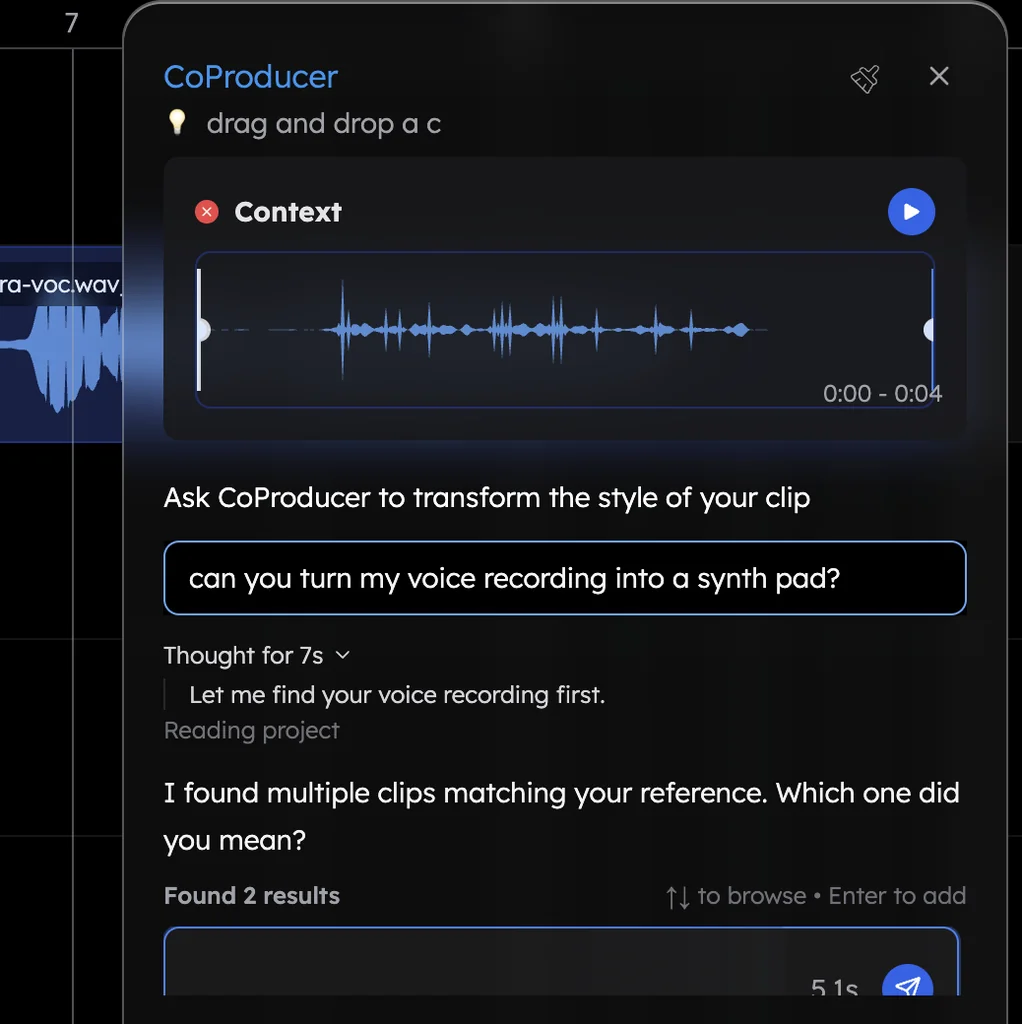
What's free in Veena
- Ownership: you own the Output you generate, on every plan, and your recordings stay yours.
- Export: WAV 24-bit/48 kHz, MP3 320 kbps, MIDI and stems, with no cap and no watermark.
- CoProducer: a daily allowance of requests. Picking or skipping options does not use it.
- The studio: timeline, piano roll, Beat Maker, mixer, recording and real-time collaboration, with no project limit.
Veena Pro, $20 a month, removes the daily request cap and unlocks the premium models.
Who owns each part is in who owns music made in Veena, and copyright in detail is in can AI music be copyrighted?. Every other answer is in the Veena help centre.
Make a 100 BPM alt-rock song in D major: 4-bar intro, 16-bar verse, 8-bar chorus, 16-bar verse, 8-bar chorus, 8-bar bridge, 16-bar double chorus. Driving Pop kit drums, overdriven rhythm guitar on power chords, a picked bass following the kick and a clean lead guitar line in the bridge. Leave space for my vocal.
Related reading: Is it legal to create AI music? · Is AI music illegal on Spotify? · Suno lawsuit ledger · Can AI music be copyrighted?
Try this in Veena
Make a 100 BPM alt-rock song in D major: 4-bar intro, 16-bar verse, 8-bar chorus, 16-bar verse, 8-bar chorus, 8-bar bridge, 16-bar double chorus. Driving Pop kit drums, overdriven rhythm guitar on power chords, a picked bass following the kick and a clean lead guitar line in the bridge. Leave space for my vocal.
Opens a new project in Veena, and CoProducer starts building from this prompt.
Frequently asked questions
Is it illegal to make music with AI?
No law makes it illegal to make music with AI. The fights are elsewhere: lawsuits against AI companies over training data, and claims over copying a real singer's voice or a real song. This is not legal advice. Veena is an AI DAW with a personal music producer built in. Describe the song you want and CoProducer builds it with you — beats, chords, melody, arrangement and mix — as real tracks you can edit, mix and export. Free, in your browser.
Can you copyright a song made with AI?
The parts a person made, yes. The US Copyright Office's report of 29 January 2025 says AI outputs can be protected "only where a human author has determined sufficient expressive elements", and that "the mere provision of prompts" is not enough (read 21 Nov 2026). In Veena you play, sing, choose and edit every part, and you own the Output you generate.
Can I get sued for making AI music?
The suits so far name AI companies, not the musicians using them: labels, publishers and collecting societies are suing Suno, and Germany's GEMA won a first-instance ruling against it in Munich on 31 July 2026 (read 21 Nov 2026). Copying a real artist's voice or song is the risk. In Veena, the voice on your song is your own recording.
Is it illegal to make AI music in an artist's voice?
It can be. Tennessee's ELVIS Act protects a person's voice, and Presley's rights holders cited it when they sued Suno on 6 November 2026, Music Business Worldwide reported (read 21 Nov 2026). Suno's own terms bar creating a voice model of another person. Veena re-sings your own recorded vocal in a voice from its library and never copies a real person's voice.
Can I release AI music legally?
Yes, when you hold the rights. That depends on the tool: Suno's help centre says free-plan songs "cannot be monetized" (read 21 Nov 2026), while Veena's terms say you own the Output you generate on every plan, free included. Export a 24-bit WAV from Veena with no watermark and release it through any distributor.
Meet your personal music producer
Free, in your browser. Describe the song you want and CoProducer builds it with you.
Make music free