How to prove you made a song
How to prove you made a song: keep the making, not just the result. One exported MP3 shows what the song sounds like, and anyone who has the file has the same proof you do. What shows authorship is the work behind it: the DAW project with every take, the stems, a screen recording of the session, a dated release and, when you wrote with other people, a signed split sheet. Veena keeps that record for you as you build, track by track, in a project that stays in your account.
Veena is an AI DAW with a personal music producer built in. Describe the song you want and CoProducer builds it with you — beats, chords, melody, arrangement and mix — as real tracks you can edit, mix and export. Free, in your browser.
How to prove you made a song: what counts as evidence
Distributors tag AI music, and those tags have become evidence: DistroKid has produced its AI-detection documents to the labels in the Suno case, as our Suno lawsuit ledger reports in its latest section. When a song is flagged, the distributor asks you to show the making. Ditto Music's appeal page (read 20 November 2026) is the clearest list of what that means:
- Your project or session file. "Project or session files from your DAW (Ableton, Logic, Pro Tools, or similar)".
- Your raw material. "Raw demo recordings or individual stems".
- The process on video. "Footage or a screen recording of your composition or production process".
- You, as an artist. "Social media accounts with a long-term history of activity", "Live performance footage" and "Published interviews or press coverage".
Ditto says it reviews an appeal "within 7 days". Every other distributor's rules are in which distributors accept AI music.
Two records sit outside the studio. The release date your distributor and the stores show is a public, dated record of when your song came out. Copyright registration is the formal one. The US Copyright Office (general FAQ, read 20 November 2026) says your work is protected "the moment it is created and fixed in a tangible form", that "registration is voluntary", and that "You will have to register, however, if you wish to bring a lawsuit for infringement of a U.S. work." It adds that "if registration occurs within five years of publication, it is considered prima facie evidence in a court of law."
What doesn't prove much
- A single exported MP3. It proves the song exists, not who made it.
- Mailing a copy to yourself. The Copyright Office calls it a "poor man's copyright": "There is no provision in the copyright law regarding any such type of protection," and it "is not a substitute for registration."
- A generator's render you can't open. A finished file with no parts, takes or stems of your own shows the tool's work, not yours. What the Copyright Office protects in AI-assisted music is in can AI music be copyrighted.
The proof file, and where Veena keeps it
| Evidence | What it shows | In Veena |
|---|---|---|
| The project | Every part, take and edit, in order | Autosaves to your account with every track, clip and edit |
| Your recordings | Your voice and your playing | Recorded from your mic onto their own tracks |
| Stems | Each part on its own | Every track exported as WAV or MP3, free, with no watermark |
| MIDI | The notes you wrote or changed | Every MIDI part exported as a .mid file |
| The master | The song as released | WAV 24-bit/48 kHz or MP3 320 kbps, no watermark |
| Ownership | That the song is yours to register | Veena's terms: you own the Output you generate, on every plan |
| Training | That your music stays yours | Veena does not train AI on your music |
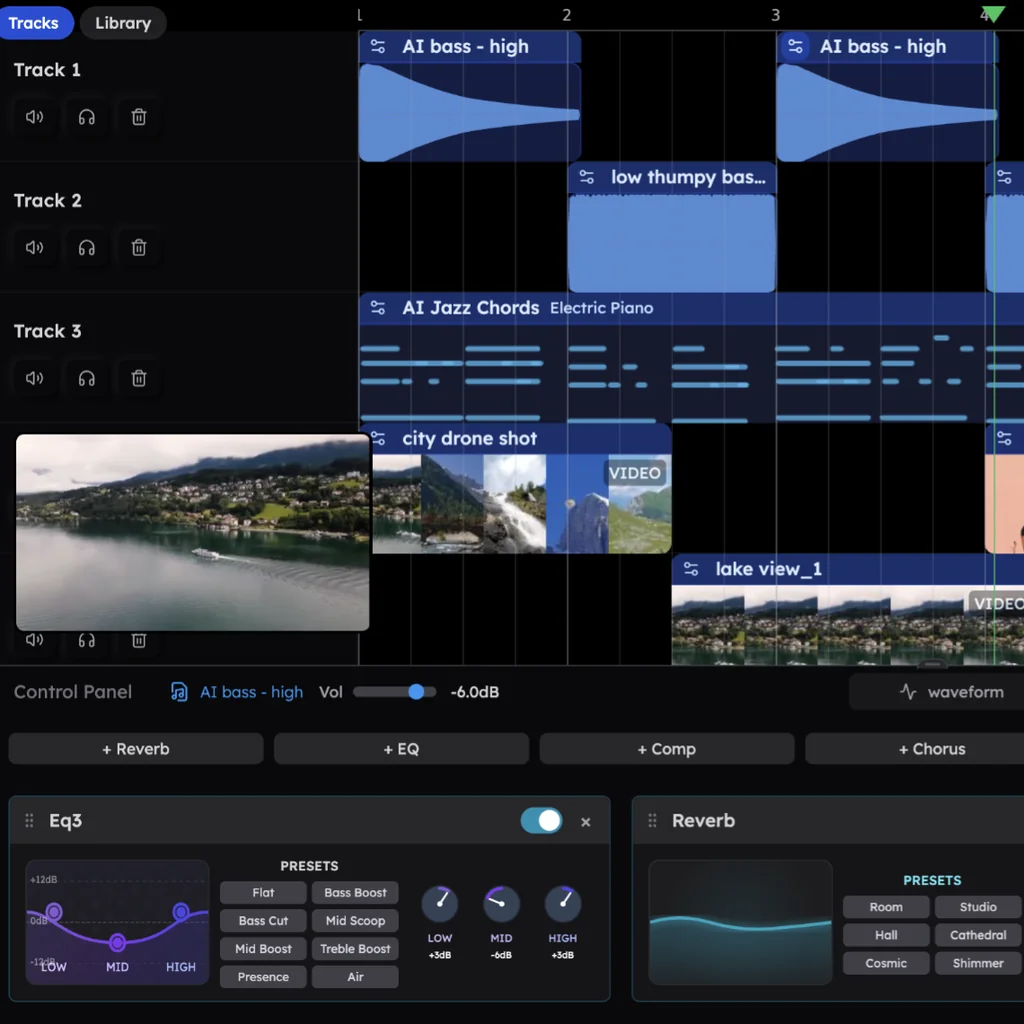
Build a song you can prove, in Veena
- Start from an empty project. Open daw.veena.studio and sign in with Google. Paste the prompt at the bottom of this page into CoProducer, and pick each part from 3 options.
- Make it yours. Record your vocal and your guitar on their own tracks, write the lyrics, and change any note CoProducer played in the piano roll.
- Record the session. Run any screen recorder while you work: it is the footage Ditto's list asks for.
- Export the proof file. Download the master as a 24-bit WAV, every track as stems and the MIDI, free, and keep them with the release.
- Release and register. Your distributor's release date is the public record; registration with the Copyright Office is the formal one.
Ownership in Veena is covered in who owns music made in Veena, and the long version of this argument is how to own the music AI helps you make.
Start a 100 BPM indie pop song in A major around my voice: a tight live-style drum kit, a round picked bass, a clean electric guitar playing A, E, F#m, D in the verse and a bright piano doubling the chords in the chorus. Intro 4 bars, verse 16, chorus 8, verse 16, chorus 8, bridge 8, final chorus 16. Leave space on its own track for my vocal.
Related reading: Veena help centre · Can AI music be copyrighted? · Which distributors accept AI music? · The Suno lawsuit · Can you tell if a song was made with AI? · Does Veena train AI on my music? · How to own the music AI helps you make · What is a split sheet?
Try this in Veena
Start a 100 BPM indie pop song in A major around my voice: a tight live-style drum kit, a round picked bass, a clean electric guitar playing A, E, F#m, D in the verse and a bright piano doubling the chords in the chorus. Intro 4 bars, verse 16, chorus 8, verse 16, chorus 8, bridge 8, final chorus 16. Leave space on its own track for my vocal.
Opens a new project in Veena, and CoProducer starts building from this prompt.
Frequently asked questions
How do you prove you made a song?
Show the making, not just the file: the DAW project, your raw takes and stems, a screen recording of the session, a dated release and, with co-writers, a signed split sheet. Ditto Music asks for exactly that kind of proof when it reviews an AI flag (read 20 Nov 2026). Veena is an AI DAW with a personal music producer built in. Describe the song you want and CoProducer builds it with you — beats, chords, melody, arrangement and mix — as real tracks you can edit, mix and export. Free, in your browser.
Do I have to register my song to own it?
No. The US Copyright Office says a work is protected "the moment it is created and fixed in a tangible form" and that "registration is voluntary", but you will have to register to sue over a US work, and registration within five years of publication is prima facie evidence in court (read 20 Nov 2026). Your Veena project is that fixed form, track by track.
Does mailing a song to yourself prove you wrote it?
Not in the US Copyright Office's view. It calls sending a copy to yourself a "poor man's copyright", says "There is no provision in the copyright law regarding any such type of protection" and that it "is not a substitute for registration" (read 20 Nov 2026). In Veena the project itself shows the work: every part, take and edit on its own track.
What do distributors accept as proof a song isn't AI?
Ditto Music's appeal page asks for "Project or session files from your DAW", "Raw demo recordings or individual stems" and "Footage or a screen recording of your composition or production process", plus a verified artist presence, and reviews it within 7 days (read 20 Nov 2026). Veena keeps your project in your account and exports every track as a stem.
Can I prove I made a song I built with AI?
Prove your part of it. Keep your own vocal, playing, lyrics and edits on their own tracks, so anyone can hear what you made beside what the AI wrote. In Veena that is how every song is built: CoProducer writes each part as an editable track, you record and change the rest, and the project keeps all of it.
Who owns a song I make in Veena?
You do. Veena's terms say you own the Output you generate, on the free plan and on Veena Pro, and your recordings and uploads stay yours. Veena does not train AI on your music, and every export, the WAV master, MP3, MIDI or every track as stems, has no watermark.
Meet your personal music producer
Free, in your browser. Describe the song you want and CoProducer builds it with you.
Make music free