Suno Says It Matches an Existing Recording? Here's Why
Suno says your upload matches an existing recording, even when it's your own. What Suno documents, what creators report, and a free studio with no filter.
When Suno says your upload matches an existing recording, it refuses the file, even if you wrote and recorded every note, and Suno's help centre doesn't say how the check works or how to clear it: none of its 130 articles mentions the message (checked 23 September 2026). Veena, the free AI DAW with a personal music producer, has no copyright bot second-guessing your own audio.
Veena is an AI DAW with a personal music producer built in. Describe the song you want and CoProducer builds it with you — beats, chords, melody, arrangement and mix — as real tracks you can edit, mix and export. Free, in your browser.
Why Suno says your song matches an existing recording
Start with what Suno has actually written down, all read on 23 September 2026:
- When you upload, you vouch for the audio. Suno's upload guide walks you through a step where you "agree to the terms stating that we own the material".
- Its terms put the risk on you. "It is very important that you only upload, post, publish, or display … Submissions that you have rights to use". Suno keeps "the right (but not the obligation) in their sole discretion to refuse or remove any content".
- Its moderation article lists what may block a song: "The names of well known artists or people", "Copyrighted or trademarked terms", and more. It adds that "Suno will follow DMCA guidelines for copyrighted material flagged by the original owner."
- The upload check itself is undocumented. No article describes what your file is compared against, how close counts as a match, or how to prove it's yours.
So the explanations come from creators. The patterns they report are consistent: songs they've already released through a distributor to Spotify or YouTube, recordings that contain licensed loops or sample-pack sounds, and songs that started life on Suno and came back after edits elsewhere. In each case the person uploading is often the person who made it.
The check runs at a company in the middle of label deals and lawsuits. Suno introduced v6 on 9 September 2026 as "a new generation of music models developed with our industry partners, including Warner Music Group, BMG and Believe", and Universal and Sony sued Suno again over v6 (MusicRadar, 22 September 2026). Suno doesn't connect its upload check to either. What it does make clear is that the call is Suno's, at its "sole discretion".
What the block costs you
A refused upload isn't a warning you can click past. It's your recording, locked out of the tools you pay for:
- The idea stops where it started. Suno's upload guide pitches uploads as the way to turn "a rough demo" into a song with Extend and Cover. A blocked file gets none of that.
- Paying buys a longer upload, not a way past the check. Free accounts upload up to 60 seconds and Pro or Premier up to 8 minutes, and no plan lists an exemption.
- There's no appeal process for a refused upload in the help centre. Its only route is the general support address for flagged content. The steps for chasing a false positive are in what to do about a Suno copyright filter false positive.
In Veena, your recording goes straight onto the timeline
Veena has no copyright filter on uploads. Nothing listens to your file and decides whether you're allowed to use it. It's built for your own music: the demo, the rehearsal take, the voice memo, the song you already released.
- Open daw.veena.studio and sign in with Google. Nothing to install.
- Drag your recording onto the timeline. WAV, MP3, M4A, FLAC, AIFF and other common formats import, and video files bring their audio with them. The file appears at once and saves to your account.
- Drag it into the CoProducer panel and describe the band you want, like the prompt at the end of this page. CoProducer measures the take first, its tempo, its downbeat and where your syllables land, sets the project tempo to match, and writes drums, bass, chords and more around it, with 3 options for every new part.
- Keep producing. Split the recording into four stems if you need to, record another take over it, mix it, and export the full mix or every track as WAV or MP3 with no cap.
You're in good company. In Veena's own data, about 1 in 4 first requests to CoProducer refer to the user's own audio: a recording, a demo, a loop or a voice memo.
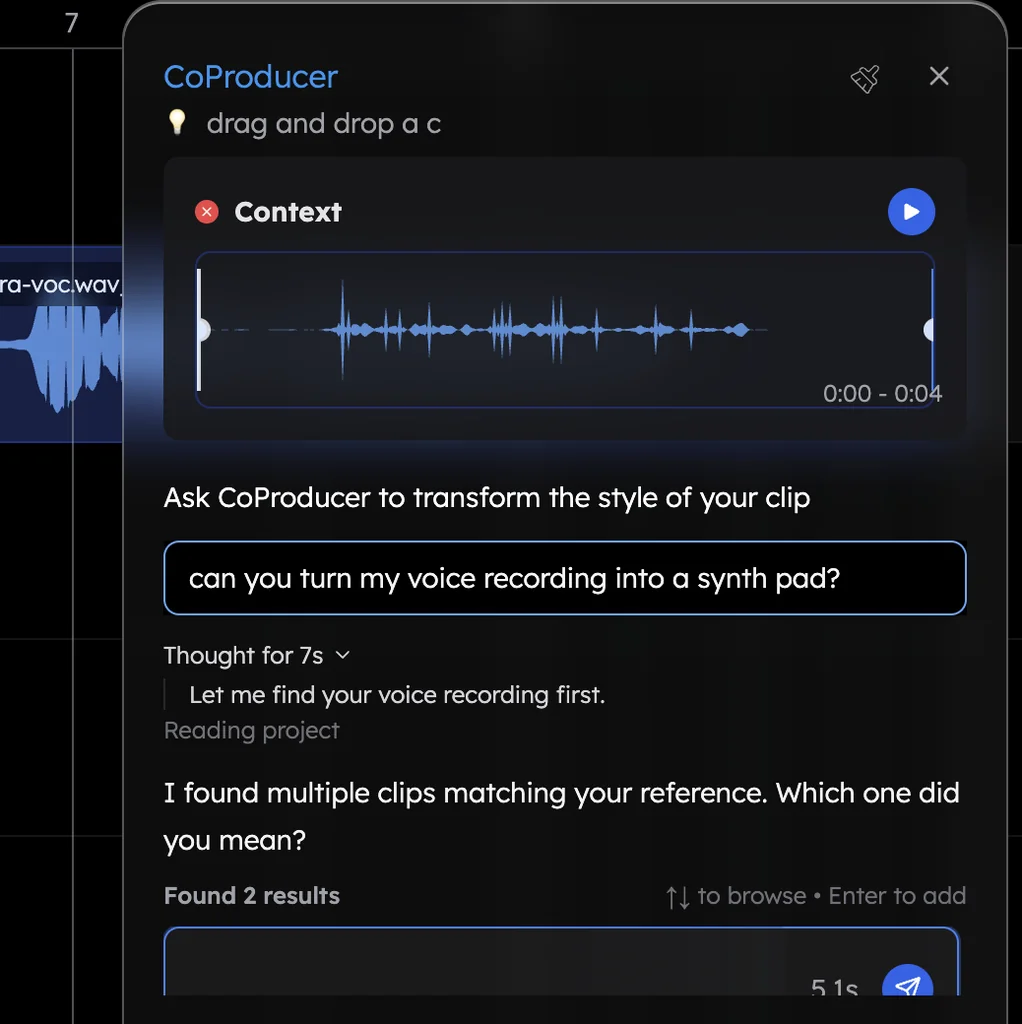
Veena's terms are plain about whose it is: "You own Your Content … We do not claim ownership of it." And what CoProducer builds with you is yours too: "you own the Output you generate through your use of the Service." As in any studio, the terms ask you to upload only what you own or have the rights to use. The difference is that Veena takes your word for it and lets you work.
Your own recording: Veena vs Suno (September 2026)
Suno facts come from Suno's help centre and Terms of Service, read on 23 September 2026.
| Veena | Suno | |
|---|---|---|
| Copyright check on uploads | None: your file goes straight onto the timeline | Creators report uploads refused as matches to existing recordings; its help centre doesn't document the check |
| Longest upload | Whole songs, demos and voice memos | 60 seconds on Free; up to 8 minutes on Pro and Premier |
| What you confirm | That you own it or have the rights, like any studio | That "we own the material" |
| What happens next | CoProducer builds new parts around it as editable tracks | Extend, Cover and other re-generations |
| Who owns a free-plan song | You do | Suno does |
| Watermark on exports | None, on any plan | Terms reserve the right to append a fingerprint, watermark or metadata |
Your music, never flagged. Bring the recording Suno turned away into Veena, and start the song it was meant to become. To split a recording into parts, try the free stem splitter; to turn a hum into an instrument, see voice to instrument; and for the whole move, read the Suno alternative guide.
Related reading: Suno copyright filter false positive · Who owns Suno songs · Veena vs Suno
Try this in Veena
Build a full band around my recording: find its tempo and key, then add live-feel drums on the JCLive kit, an Electric Bass (finger) line that follows my phrasing, Acoustic Guitar (steel) strums and a String Ensemble swell in the last chorus.
Frequently asked questions
Why does Suno say my song matches an existing recording?
Suno doesn't publish how its upload check works, and none of its help-centre articles explains the message. Creators report it most on songs they've already released to streaming services and on recordings that contain licensed loops. Veena, a free AI DAW with a personal music producer, has no copyright filter on uploads: your recording goes straight onto the timeline.
Can I upload my own released song to Veena?
Yes. Veena has no copyright bot checking your uploads: drag in your song, demo or voice memo and it lands on the timeline, where CoProducer can build new parts around it. Veena's terms say you own Your Content and that Veena does not claim ownership of it. As in any studio, upload music you own or have the rights to use.
How do I contact Suno about a blocked upload?
Suno's moderation article says "If you're unsure why certain content was flagged, feel free to reach our team at support@suno.com." Include proof the recording is yours, such as session files or your distributor listing. While you wait, you can keep working on the same recording in Veena, free in your browser, with nothing checking it at the door.
Does Veena watermark or fingerprint my exports?
No. Veena adds no watermark and no provenance tag to your exports, on any plan, and exports have no cap: WAV 24-bit/48 kHz, MP3 320 kbps, MIDI, the full mix or every track. Suno's terms, by contrast, reserve the right to append a fingerprint, watermark or metadata showing an Output's service tier and whether it was a permitted download.
Meet your personal music producer
Free, in your browser. Describe the song you want and CoProducer builds it with you.
Make music free