Why Suno Falls Apart the Moment You Want Control
Suno renders a song; producers need to change one part. Suno's own pages, rechecked September 2026, show the control gap. Veena, a free AI DAW, closes it.
Every producer hits the same moment with Suno. The first render lands, a full idea from a sentence. Then you want to change one thing — move the snare, drop the key, rebuild the bridge — and the song Suno rendered has no parts to reach into. Veena, an AI DAW with a personal music producer, is built for exactly that moment, free in your browser.
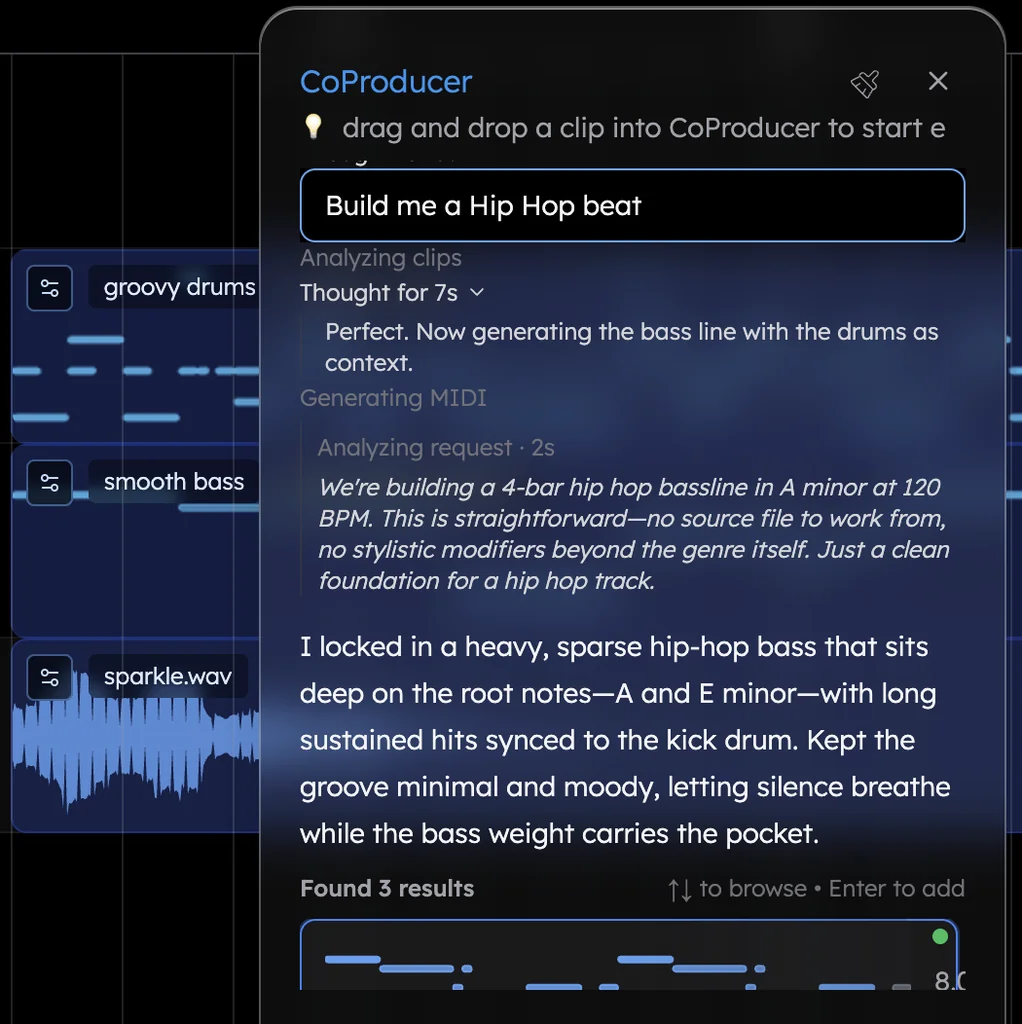
Veena is an AI DAW with a personal music producer built in. Describe the song you want and CoProducer builds it with you — beats, chords, melody, arrangement and mix — as real tracks you can edit, mix and export. Free, in your browser.
That's the control gap. Suno is built to generate, not to be controlled, and once you see why, the limitation stops feeling like a bug and starts looking like the architecture. The deeper pattern is in why AI music generators can't edit.
What changed in September 2026
Suno changed a lot this month, and the control gap moved with it. From Suno's own blog, help centre and Terms (read 23 September 2026):
- v6 (9 September) edits in words. Suno's v6 FAQ lists "Edit part of an existing song using plain language" and "Update a single lyric without rebuilding the entire song." Useful, and still generation: you ask, and new audio comes back.
- Every earlier model is retired. "Retiring a model means you can't generate new songs with it," and extending or covering an older song "will run on the new models, so results may sound different from the original generation."
- Each generation is metered. "Each time you generate, you make two songs with a total cost of 10 credits."
- Downloads are capped (3 September). Pro 20 a month, Premier 60, free accounts up to 7 lifetime, older songs included (Suno's paywall on old songs); only Studio exports on Premier are uncapped.
- The timeline is Premier-only. Suno Studio, where you'd see parts on tracks, "is included in the Premier subscription tier", $30 a month.
Built for a render, not for a change
Generation and editing are different jobs. Generation produces a finished-feeling whole from a prompt. Editing means reaching into that whole and changing one element while everything else stays put.
When you want one specific element changed in Suno, you ask again. v6 can take "Change the chorus so it's sung by a gospel choir" and regenerate that section, but what comes back is new audio: the chord voicing you loved, the ghost notes in the hats, the exact pocket of the bass can all move with it. There's no scalpel, only a better-aimed roll of the dice.
Re-rolling costs credits, even when it misses
Here is where the control gap turns into a money problem. Every generation makes two songs and spends 10 credits, whether you keep either one or not. Subscription credits "do not carry over from day to day or month to month", so a month of careful work and a month of misses cost the same.
Iteration is the whole job of production. A tool that charges per attempt at the thing you do most is fighting your workflow. The maths is in the credit-burn trap.
Bars, key and the grid
The deepest issue is musical. Real production runs on precise targets: "fix bar 9", "this section is in the wrong key", "extend the outro by four bars", "put the snare on 3". Those are instructions about parts on a grid, and a rendered song has no parts, only a mix.
Even inside Suno Studio, where the parts live on tracks, Suno's own help article warns that "some users may experience timing issues, where new generations fall slightly in front of or behind the beat," and asks you to be "rigorous about checking the timing." And Studio is "not compatible with VST or Audio Units plugins", so the tools you'd use to fix it stay outside.
Prompt-to-song is a creative dead end for anyone who needs to finish a record, a case we make in full in why prompt-to-song is a dead end.
What control looks like
The fix isn't a better prompt box. It's a different architecture: a personal producer inside a real, fully editable DAW.
In Veena, you describe the song and CoProducer builds it with you. It plans the sections, sets the tempo and key, and writes drums, bass, chords and melody as separate tracks, offering 3 options for each part and waiting for your pick. Then everything stays editable: move the snare to beat 3 in the drum step sequencer, transpose the chorus in the piano roll, swap the piano for a Rhodes, or tell CoProducer "extend the outro by four bars and drop the drums for the last two". A part that has to fit another reads that part's actual notes before it is written, so changes land in key and on the grid. One undo reverses any change CoProducer makes.
Bring your own music too: drag in a demo, split it into 4 stems, and CoProducer builds new parts around it. Load your own VST3 and AU plug-ins through Veena Bridge. Export WAV, MP3 or MIDI, every track, with no cap.
Veena vs Suno on control (September 2026)
| Veena | Suno | |
|---|---|---|
| What you get | An AI DAW with a personal producer: your song as real tracks | A rendered song |
| Edit one element | Edit the note, clip or sound directly, or ask in plain words | Ask v6 to regenerate a section |
| Cost to iterate | Editing by hand is free; picking options doesn't count; failed runs refunded | Two songs per generation for 10 credits |
| Timing | Parts written as MIDI on your project's grid | Studio lists a timing issue with new generations |
| The timeline | Free, on every plan | Studio, Premier only at $30 a month |
| Getting music out | No cap: the mix or every track | Free 7 lifetime, Pro 20 a month, Premier 60 a month |
| Ownership | "You own the Output you generate", every plan | Suno keeps free-tier songs |
Stop re-rolling and start editing. For every other way out, see the Suno alternative guide, and for what's changed at Suno this month, the Suno v6 review. Start free in your browser.
Related reading: Veena vs Suno Studio · Suno download limits · what Suno cannot do · is Veena better than Suno?
Try this in Veena
Make a 92 BPM boom-bap beat in G minor: a punchy kick, a snare with a little room, swung 16th hi-hats, a round bass that follows the kick, a dusty piano chord loop and a sparse flute counter-melody in the hook. Intro 4 bars, verse 16, hook 8, verse 16, hook 8, outro 4.
Frequently asked questions
Can't I just write better prompts in Suno?
Better prompts help the first generation, but a prompt still returns rendered audio. Suno's v6 can redo a section when you ask in plain words, yet every generation costs credits ("two songs with a total cost of 10 credits") and you can't reach in to move one snare hit. In Veena, CoProducer writes each part as a real track, so you change the note itself in the piano roll.
Why is re-rolling such a problem?
Because it's imprecise and metered. A new generation can replace the parts you wanted to keep, and Suno bills it either way; its subscription credits "do not carry over from day to day or month to month" (Suno's pricing page, September 2026). In Veena, editing by hand is never metered, picking between CoProducer's 3 options doesn't count, and failed runs are refunded.
How does Veena handle the control gap?
Veena is an AI DAW with a personal music producer built in: CoProducer builds the song as real tracks, then you edit every note, sound and effect directly or ask for changes in plain words. A part that must fit another reads that part's actual notes first, so changes land in key and on the grid, and one undo reverses any CoProducer change.
Did Suno v6 fix editing?
It added plain-language edits of a section or a lyric, but the result is still newly generated audio, and since 9 September 2026 extensions, remixes and covers of older songs "will run on the new models, so results may sound different from the original generation" (Suno's help centre). Veena edits the real parts on your timeline, so nothing you liked changes unless you change it.
Meet your personal music producer
Free, in your browser. Describe the song you want and CoProducer builds it with you.
Make music free