Mozart AI Review: Prices, Rights and the Fine Print
Mozart AI review from its own pages: plans from $10 a month, no commercial use on free since June 2026, uploads licensed for AI training. Verdict: Veena.
Our Mozart AI review in one line: Mozart is a chat-first AI song generator with a studio attached, and the fine print costs you. Since 24 June 2026 free songs can't be released, credits don't roll over and uploads are licensed for AI training, voice included. Veena, the free AI DAW with a personal music producer, is the better studio.
Veena is an AI DAW with a personal music producer built in. Describe the song you want and CoProducer builds it with you — beats, chords, melody, arrangement and mix — as real tracks you can edit, mix and export. Free, in your browser.
This review is built only from Mozart's own pages: its website, its pricing page, its terms of service (last revised 23 June 2026) and its App Store listing, all read on 23 September 2026. No anonymous reviews, no guesses.
What Mozart AI is
Mozart AI is made by Arthos Inc., founded in 2024, and its homepage title says what it sells: "Mozart AI - AI Song Generator & Music Maker". The slogan is "The AI Music Generator Built for Artists", and its App Store listing is "Mozart AI: Song Generator Music Maker: Vocals & Lyrics".
It works in two modes:
- Vibe Sessions, "Mozart's text to music AI mode where an AI agent acts as your co-producer": you describe a genre, mood and tempo, the song generator creates the track, and you refine it by chatting.
- Studio, "our online DAW", with a piano roll, drum patterns, a mixer channel, MIDI and audio export, audio-to-MIDI, inpainting and a "Clip Agent".
Its own how-to runs in that order: start a Vibe Session, describe the song, generate and refine, then "Polish in Studio", then export. The song is generated first; the studio is where you go afterwards. Around it sit music videos, cover art, lyrics and "Personas", which the pricing page calls "Custom models of your style/voice".
Plans and prices
| Plan | Price | Credits | What the plan adds |
|---|---|---|---|
| Free | $0 | 80 on sign-up (about 10 songs), plus 20 a day | Downloads, cover art; personal use only |
| Creator | $10 a month or $84 a year | 2,875 a month | Commercial use, stem split, AI mastering; music videos up to 30 seconds "with watermark" |
| Pro | $18 a month or $180 a year | 7,750 a month | Videos up to 1 minute, advanced mastering, "advanced editing on the web app" |
| Premium | $30 a month or $300 a year | 21,250 a month | Videos up to 4 minutes, "advanced editing on the web app" |
Sources: Mozart's pricing page and its App Store in-app purchases (where Pro's year is $179.99), September 2026.
Three things in the small print:
- Credits expire. "Credits refresh each billing cycle and do not roll over" (App Store listing).
- No refunds. Payments "are nonrefundable and there are no credits for partially used periods" (terms).
- The free allowance depends on the page. The pricing page promises "80 credits on sign-up (~10 songs)"; the App Store listing says "Every new account gets 180 free credits".
Rights: what changed on 24 June 2026
This is the part of any Mozart AI review that matters most if you plan to release music.
Mozart's terms say "you own your Output", then make what you may do with it depend on what you were paying when you made it. From 23:59 British Summer Time on 24 June 2026, "commercial use of Output requires a subscription to a Qualifying Paid Plan", which the terms define as Creator, Pro and Premium. The homepage puts it plainly: "Commercial use (distribution, monetization, sync, releasing your songs) requires a Creator subscription or higher."
- No retroactive rights. "Upgrading to a Qualifying Paid Plan does not grant commercial-use rights in Output previously generated at a time when you were not subscribed."
- Remixes are never commercial. A remix of another user's song is "jointly owned equally" with that user and, after 24 June 2026, "may not be used for any commercial purpose", on any plan.
- No copyright promise. Mozart "makes no representation or warranty to you that any copyright or other intellectual property rights will vest in any Output."
- Mozart's pages disagree. The App Store listing still says "All plans include full commercial rights." The terms and the website say the opposite, and the terms are the contract.
What you give Mozart
By using the service and uploading anything, you grant Mozart and its affiliates a licence to use your content "to develop, train or otherwise improve or modify our artificial intelligence and machine learnings model(s)", and the terms add that this licence "includes a license to the likeness, voice rights, and other indicia of the persona that may be embodied in Your Content". Your prompts, your lyrics, your uploaded audio and your voice all sit inside that licence.
The ratings claim
Mozart's homepage tells search engines, through its structured data, that it holds a 5.0 rating from 1,000 reviews, and names no source for it. A public rating on a page Mozart doesn't control, its App Store listing, shows 4.6 out of 5 from 582 ratings (23 September 2026).
Mozart AI vs Veena (September 2026)
| Veena | Mozart AI | |
|---|---|---|
| What it is | An AI DAW with a personal music producer | "AI Song Generator & Music Maker" |
| How a song starts | CoProducer builds real tracks from one sentence, part by part | A Vibe Session generates the track; Studio comes after |
| Releasing free-plan songs | Yes: you own the Output you generate | No, since 24 June 2026 |
| Stems | 4 stems on every plan, lined up on your timeline | From Creator ($10 a month) |
| Mixing and mastering | CoProducer balances and masters the mix, on every plan | AI Mastering from Creator; advanced mastering from Pro |
| Unused credits | Veena Pro credits roll over while you stay subscribed | "Do not roll over" |
Verdict: Veena is the better studio
Mozart's pitch is a producer you chat with. Veena puts that producer inside the DAW from the first sentence, free, and without the fine print.
- Open Veena in your browser and sign in with Google. Nothing to install.
- Paste the EDM prompt at the end of this review. CoProducer sets 126 BPM and G minor and maps the breaks, builds and drops with their bar lengths.
- Pick each part from three options: kick and hats, the saw bass, the supersaw chords, the pluck hook. The bass reads the kick you chose before it is written.
- Direct it. "Make the second drop bigger." "Thin out the hats in the break." "Swap the pluck for a brighter lead." Or edit notes in the piano roll; one undo reverses any CoProducer change.
- Make it yours. Record your vocal, or hum a hook and turn it into a lead synth with voice to instrument. Bring in your own VST3 and AU plugins through the Veena Bridge, and invite a collaborator into the session.
- Export with no cap. The full mix or every track as stems, in WAV 24-bit/48 kHz, MP3 320 kbps or MIDI, with no watermark on your exports.
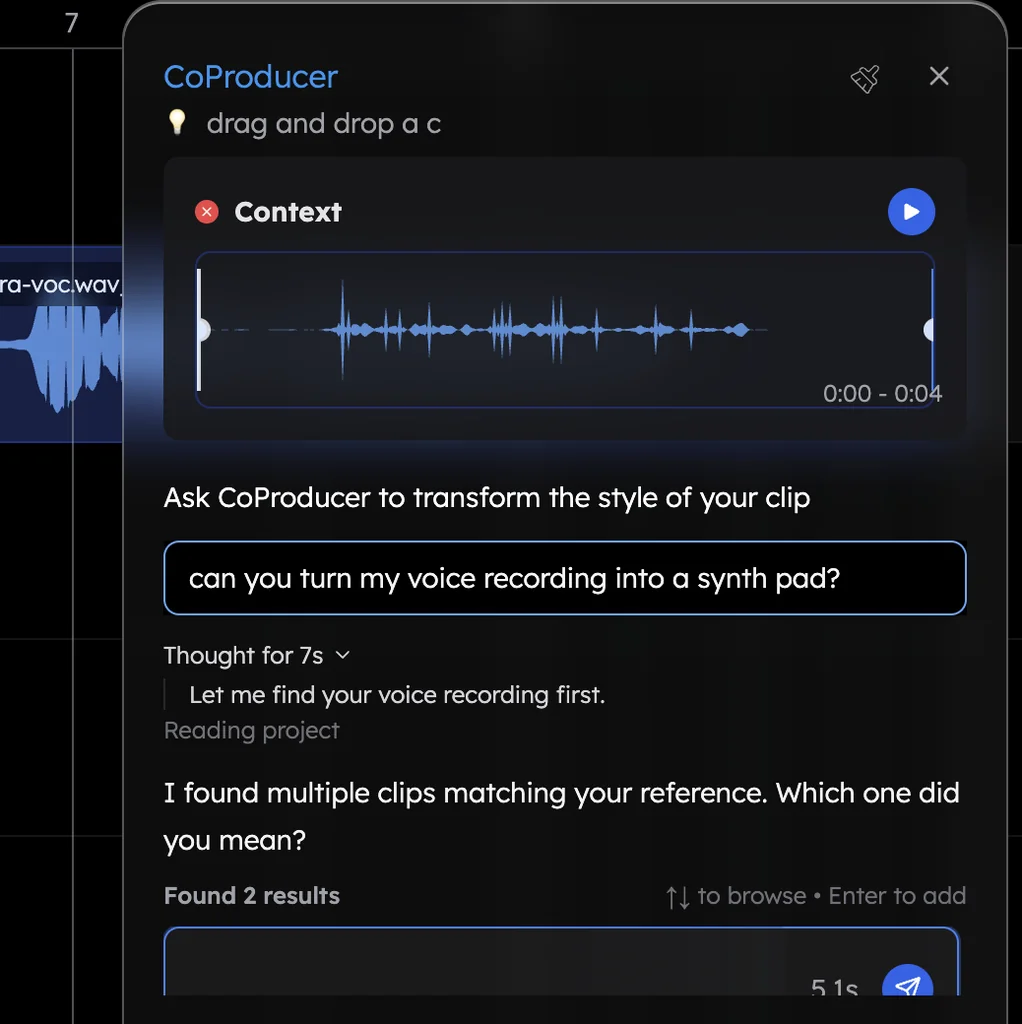
In Veena's own data, first requests that ask for EDM get a finished first result on day one 90.7% of the time.
You own what you make on every plan, the studio is free, and Veena Pro at $20 a month only removes the daily request cap and unlocks the premium models. For the head-to-head, read Veena vs Mozart AI; if you are also leaving Suno, our Suno alternative guide covers it.
Related reading: Mozart AI alternative · Veena vs Mozart AI · Veena vs Suno · The best Udio alternative
Try this in Veena
Make a 126 BPM melodic EDM track in G minor: a punchy four-on-the-floor kick, offbeat hats, a driving saw bass, a wide supersaw chord stack in the drop, a plucky lead hook and a rising build with snare rolls. Intro 16 bars, break 16, build 8, drop 16, break 8, build 8, drop 16, outro 16.
Frequently asked questions
Is Mozart AI good?
Mozart AI is a chat-first AI song generator with a studio attached. Since 24 June 2026 its free songs can't be released, credits don't roll over, and its terms license everything you upload, voice included, for AI training. Veena is the better studio: a free AI DAW where CoProducer builds your song as real tracks you own on every plan.
Is Mozart AI free?
Mozart has a free plan with 80 credits on sign-up (about 10 songs) and 20 credits a day, per its pricing page, while its App Store listing says 180 free credits (September 2026). Free songs are for personal use only. Veena's free plan includes the whole studio, 4-stem separation and exports with no cap, and you own what you make.
How much does Mozart AI cost?
Creator is $10 a month or $84 a year, Pro $18 a month or $180 a year, and Premium $30 a month or $300 a year, on Mozart's pricing page and App Store listing (September 2026). Payments are nonrefundable and credits don't roll over. Veena's studio is free; Veena Pro is $20 a month, and its unused credits roll over while you stay subscribed.
Can you use Mozart AI songs commercially?
Only songs generated while you pay for Creator, Pro or Premium. Mozart's terms made commercial use subscription-only from 24 June 2026, upgrading doesn't cover earlier free songs, and remixes of other users' songs are never commercial. In Veena you own the Output you generate on every plan, including the free one, and your exports carry no watermark.
What is the best Mozart AI alternative?
Veena. Veena is an AI DAW with a personal music producer built in. Describe the song you want and CoProducer builds it with you — beats, chords, melody, arrangement and mix — as real tracks you can edit, mix and export. Free, in your browser, with your own plugins, real-time collaboration and no cap on exports.
Meet your personal music producer
Free, in your browser. Describe the song you want and CoProducer builds it with you.
Make music free